Mole and wart removal · skin biopsy
Everything we remove · gets examined
Moles, warts, cysts, changing lesions and ingrown nails are handled in the office, under local anesthesia. At iki, minor skin surgery follows a simple rule: first the lesion is examined, then we decide how to remove it. And all tissue removed is sent to pathology, even if it looks harmless.

Mole and wart removal at iki is a minor skin surgery procedure done in the office under local anesthesia. Depending on the lesion, we use a biopsy, scalpel excision, curettage or cryotherapy. All removed tissue is sent to pathology to confirm what it was. Warts are usually treated with cryotherapy and may need several sessions. Any procedure that cuts the skin leaves a scar, small and planned.
- Duration
- 15–60 min depending on the procedure
- Anesthesia
- Local · only in the area
- Pathology
- All removed tissue is examined
- Recovery
- Normal activity · wound care
- Stitches
- If sutured · removed in 1–2 weeks
- Procedures
- Biopsies, excisions, cryotherapy, nails
Who it’s for · and who it isn’t
Indicated when
- Moles that have changed shape, color or size, or that itch or bleed
- Warts, seborrheic keratoses and skin tags that bother you or get irritated
- Epidermoid cysts and benign lesions you want removed
- Lesions that need a biopsy for a diagnosis
- An ingrown nail that keeps coming back, or nail changes that need to be examined
Not the right time if
- Strong suspicion of melanoma, or lesions that need wide margins · the workup is done and you are referred to a surgical specialist
- Large lesions in complex areas, such as the edge of the eyelid · these are referred
- Anyone looking to have a mole burned off with a laser without examining it · we don’t do that at iki
- Active infection in the area, or use of blood thinners without a prior medical review
The physician makes the final indication at the consultation. Results vary from patient to patient.
What mole and wart removal looks like at iki
Each lesion has its own technique. The procedure is performed by iki’s medical team, founded by Dr. Urbani, physician specialized in sensitive and reactive skin.
Examining the lesion
The lesion is examined with dermoscopy and the ABCDE rule: asymmetry, irregular borders, multiple colors, a diameter over 6 mm, and evolution or change. A mole that looks different from the others also counts.
Choosing the technique
Punch or scalpel biopsy to diagnose · complete excision for moles, cysts and small tumors · curettage for superficial lesions · cryotherapy with cold for warts and keratoses. For nails, a nail plate or nail matrix biopsy, or a partial matricectomy if the ingrown nail keeps recurring.
Local anesthesia and procedure
Only the area is numbed, with a small injection. After that the procedure doesn’t hurt, though you may feel pressure. If sutures are needed, the wound is closed with fine stitches, with the scar in mind.
Pathology
The removed tissue is sent to pathology, where it is examined under a microscope. That confirms what the lesion was and whether it was removed completely.
Follow-up and results
At the follow-up the stitches are removed, the wound is checked and the pathology result is explained. If the report calls for it, the next step or referral is defined.
What it offers
A diagnosis, not just a removal
Pathology tells you what the lesion was. A mole removed without examination is a question left unanswered.
In the office
Local anesthesia and a return to normal activity the same day in most cases.
Technique matched to the lesion
Scalpel, curettage or cryotherapy are chosen by the type of lesion and the scar to expect in each area.
Judgment to refer
When a case goes beyond what can be handled in the office, we say so and refer you with the information ready.
Technology with an indication
Minor surgery, cryotherapy and pathology
There is no star machine · there is surgical technique, instruments and a pathology lab. Cryotherapy freezes the lesion so it falls off. Scalpel excision removes the whole lesion with a margin of healthy skin. Corticosteroid injection helps flatten thickened scars and keloids.
Results and aftercare
The wound usually closes in one to two weeks, and the scar matures over several months: it looks pink at first and then lightens. It never disappears completely, but it is planned to be as discreet as possible. Warts can come back and sometimes need more than one cryotherapy session. The pathology result is reviewed at the follow-up.
Aftercare after the session
- Keep the wound clean and dry, and care for it as described in writing
- Don’t pick off scabs or the skin that forms after cryotherapy
- Avoid pools, the ocean and intense exercise while the wound closes
- Sunscreen on the scar for several months so it doesn’t darken
- Contact us if you have increasing pain, warmth, pus or bleeding that doesn’t stop
Results vary from patient to patient.
Pairs well with
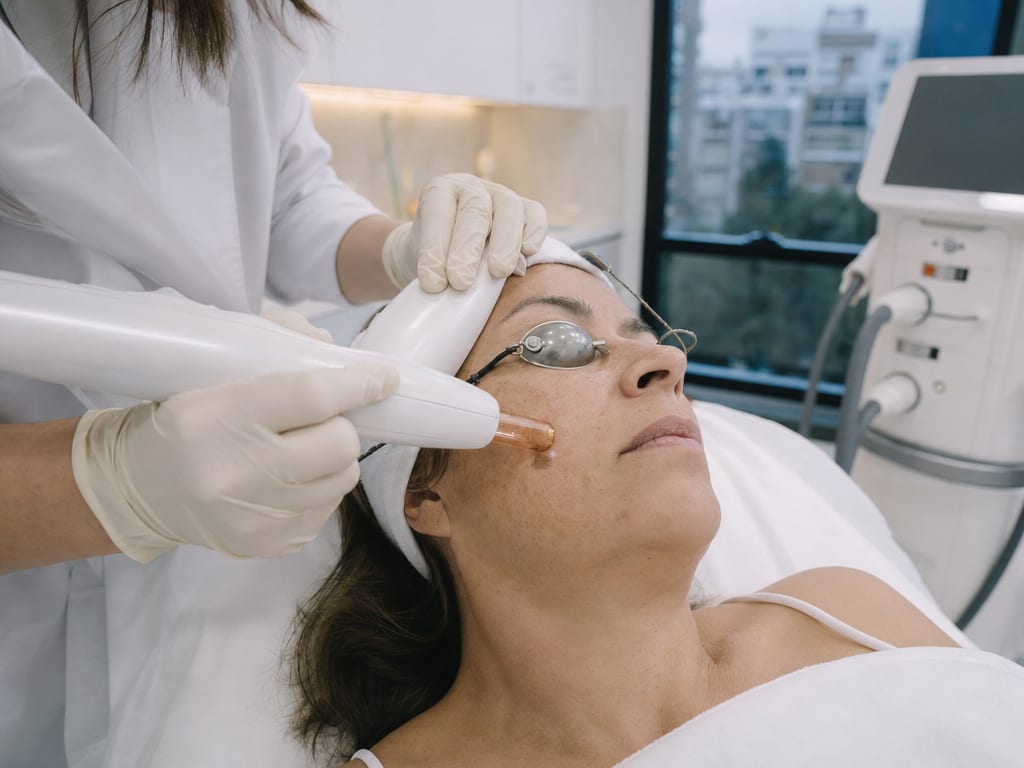 Dark spots and pigmentation
Q-Switched Nd:YAG for dark spots
The Stellar M22’s Q-Switched Nd:YAG fires very short pulses of light that break pigment into particles your body clears little by…
See treatment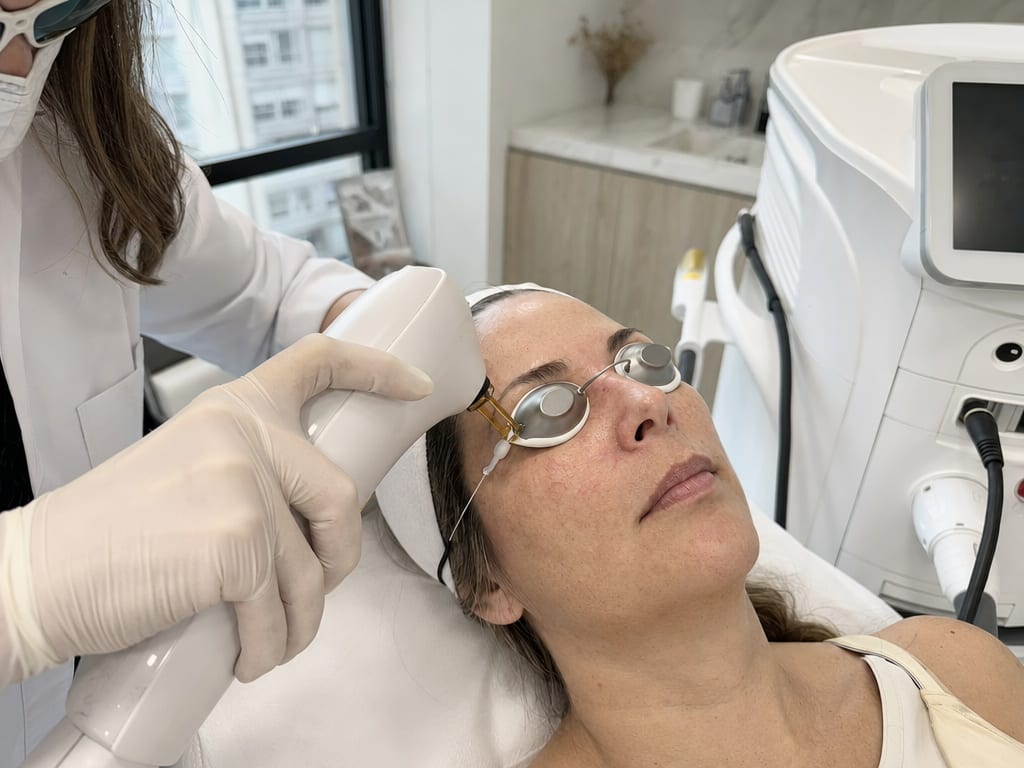 Rosacea and facial veins
Nd:YAG for telangiectasias
Telangiectasias are small dilated blood vessels visible on the nose and cheeks, often linked to rosacea or sun damage. The Nd:YAG…
See treatmentFrequently asked questions
When should I worry about a mole?
When it meets any of the ABCDE criteria: it’s asymmetric, has irregular borders, several colors, measures more than 6 mm or has changed. Also if it itches, bleeds, crusts or looks different from your other moles. No single sign confirms cancer, but every one of them justifies a prompt medical check.
Why does everything removed go to pathology?
Because you can’t always tell what a lesion is just by looking. Pathology examines it under a microscope and confirms whether it was benign and whether it was removed completely. If a lesion is burned off or removed without examination, that information is lost and can never be recovered.
Does mole removal hurt?
What you feel is the prick of the local anesthetic, which lasts a few seconds. After that the area is numb and the procedure doesn’t hurt, though you may feel pressure or tugging. When the anesthetic wears off, discomfort is usually mild and managed with the physician’s instructions.
Will there be a scar?
Yes. Every procedure that cuts the skin leaves a scar. The aim is for it to be small and discreet: it is oriented along the skin’s natural lines and closed with fine stitches. Its final appearance depends on the area, the size of the lesion, how each person tends to scar and sun care.
How are warts removed?
Most are treated with cryotherapy, which freezes the wart so it falls off over the following days. A blister and then a scab may form. Warts are caused by a virus and can come back, which is why several sessions are sometimes needed. Some lesions are better removed with curettage.
What can be done about an ingrown nail that keeps coming back?
If the nail grows in again and again, a partial matricectomy can be done: under local anesthesia, the edge of the nail that digs in and the part of the root that produces it are removed, so that edge doesn’t grow back. It is done on a single side, and the rest of the nail is preserved.
When are you referred to another specialist?
When pathology confirms a melanoma, when a malignant lesion needs wide margins or additional tests, or when the lesion is in a complex area, such as the edge of the eyelid. In those cases we explain the result, hand over the complete information and guide you to the right specialist.
How much does it cost to remove a mole or a wart?
It depends on the type of lesion, its size, the area, the technique and whether it needs pathology testing. That’s why we don’t give a figure without seeing the lesion. At the consultation, which is free and takes 45 minutes, it is examined and you receive a written plan with the full price.
Is Minor skin surgery right for you? · we’ll see at the consultation
Forty-five minutes with a physician, a skin analysis and a written, phased plan with complete prices. You decide afterwards, with no pressure. Living abroad? Start with a virtual consultation.